
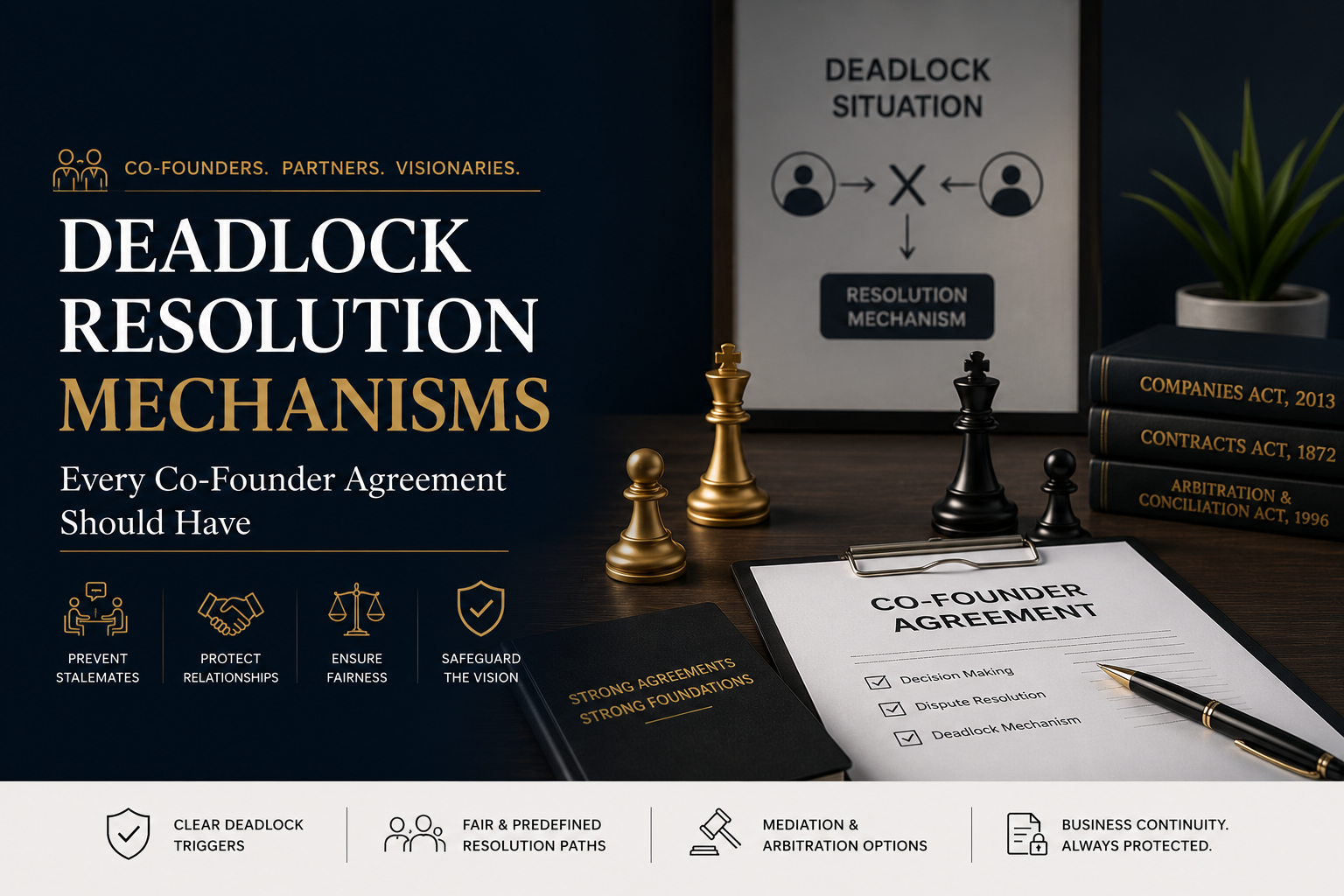
Deadlock Resolution Mechanisms Every Co-Founder Agreement Should Have
A practical and legal guide for founders, investors, and boards in India
Introduction
Most co-founder agreements are written on a good day — when the idea is fresh, the equity split feels fair, and nobody can imagine a future where they won’t agree. That is precisely why deadlock clauses get skipped, diluted into a single vague line, or copy-pasted from a template without real thought.
A deadlock is not a hypothetical risk. It is one of the most common — and most corrosive — failure modes in closely held companies and startups. Unlike a listed company with a dispersed shareholder base, a startup with two or three founders holding roughly equal stakes has no natural majority to break a tie. When co-founders stop agreeing, the company doesn’t merely slow down — it can freeze entirely, unable to pass board resolutions, approve budgets, hire, fire, raise capital, or even hold a valid meeting.
This article lays out, in detail, what a deadlock actually is in law, why founders need to plan for it contractually rather than hope it never happens, the range of resolution mechanisms available, how Indian courts and tribunals have approached related disputes, and what the current data tells us about how these disputes are actually being resolved in 2025–2026.
What Is a “Deadlock,” Legally Speaking?
A deadlock typically arises when:
- The Board is evenly split on a resolution and there is no casting vote or tie-breaking mechanism;
- Shareholders holding equal or near-equal stakes cannot agree on a matter requiring their approval;
- A “reserved matter” — something requiring special or unanimous consent under the shareholders’ agreement — cannot secure the required approval; or
- Quorum requirements cannot be met at consecutive board or general meetings because one side simply stops attending.
Deadlock is not limited to 50:50 joint ventures. It can occur even where shareholding is disproportionate, if the minority founder or investor holds veto rights or affirmative voting rights over specified matters. The critical design decision for founders is deciding, upfront, which matters are important enough to require this level of protection — because an overly long list of “reserved matters” turns ordinary disagreements into recurring deadlocks.
The Legal Foundation in India
Articles of Association vs. Founders’/Shareholders’ Agreements
Founders often rely entirely on a private agreement between themselves — a “Founders’ Agreement” or “Co-Founder Agreement” — without mirroring its key protections into the company’s Articles of Association (AoA). This is a serious structural risk.
The Supreme Court, in V.B. Rangaraj v. V.B. Gopalakrishnan (1992), held that restrictions on the transfer of shares are enforceable against the company only if they are contained in the Articles of Association — a private agreement between shareholders, however carefully drafted, does not by itself bind the company if it is not reflected in the AoA. This principle has been consistently applied since, including by the Gujarat High Court in Mafatlal Industries Ltd. v. Gujarat Gas Co. Ltd. (1999), which upheld contractual lock-in and transfer restrictions on the basis that they did not impose an absolute restraint on transferability.
The practical implication for co-founders: whatever deadlock and exit mechanism you agree to — a shotgun clause, a casting vote, a mandatory buy-sell trigger — must also be written into the AoA, not just the founders’ agreement, for it to be enforceable against the company itself and third parties.
Statutory Backstop: Sections 241–244 of the Companies Act, 2013
Where a contractual deadlock mechanism does not exist, breaks down, or is deliberately circumvented by one founder to consolidate control, the aggrieved shareholder’s principal statutory remedy in India is a petition to the National Company Law Tribunal (NCLT) under Sections 241 and 242 of the Companies Act, 2013, alleging oppression and mismanagement. Section 244 prescribes the eligibility threshold to file such a petition — broadly, at least one-tenth of the issued share capital, or 100 members, whichever is lower, for companies with share capital.
Under Section 242, if the NCLT is satisfied that the company’s affairs are being conducted in a manner oppressive to a member or prejudicial to the company, it has wide remedial powers — it can regulate the conduct of the company’s affairs, order share transfers or purchases, set aside transactions or resolutions, and in appropriate cases, order interim relief such as freezing bank accounts or ordering forensic audits.
It is important for founders to understand that this is a statutory backstop of last resort — not a substitute for a well-drafted contractual deadlock mechanism. NCLT proceedings are adversarial, public in the sense of generating a tribunal record, and — as the data below shows — currently subject to significant delay.
Types of Deadlock Resolution Mechanisms
A well-drafted deadlock clause typically has two parts: first, an escalation mechanism aimed at amicable resolution; second, a fallback mechanism that provides a definitive, self-executing way out if amicable resolution fails.
1. Escalation and Cooling-Off Mechanisms
The first step in most well-drafted clauses is a mandatory cooling-off period, followed by escalation to designated senior representatives of each side — sometimes informally called a “gin and tonic” clause, referring to a time-bound, principal-to-principal conversation intended to de-escalate before anything formal is triggered. This is low-cost, preserves the relationship, and resolves a surprising number of disputes that look intractable on paper.
2. Casting or Deliberative Vote
A designated person — typically the Chair — is given an extra, tie-breaking vote in the event of a deadlock at Board level. This is simple and fast, but founders frequently cannot agree upfront on who should hold this power, which is itself often a symptom of the deeper trust issue that will eventually cause the deadlock.
3. Referral to Shareholders / General Meeting
Some agreements provide that a Board-level deadlock is escalated to a shareholder vote. This only works if the shareholder base is not deadlocked in the same proportions as the Board — otherwise it simply moves the same impasse up a level.
4. Independent Expert or Arbitrator Referral
For matters that are more factual or technical in nature (such as a valuation dispute or a disagreement over whether a financial or operational threshold has been met), referring the specific question to an independent expert — rather than a full arbitration — can be faster and cheaper.
5. Mediation
Mediation offers a collaborative, confidential process, and is increasingly encouraged by Indian law — including under the Mediation Act, 2023 and Section 12A of the Commercial Courts Act, 2015, which mandates pre-institution mediation for certain categories of commercial disputes. However, founders should go in with realistic expectations: government data shows mediation settlement rates in India are currently very low (see data section below), and mediation does not, by itself, produce a binding outcome unless both sides genuinely want one.
6. Institutional or Ad Hoc Arbitration
Where escalation and mediation fail, arbitration under the Arbitration and Conciliation Act, 1996 is the most commonly used binding mechanism in Indian shareholder and co-founder agreements. It offers confidentiality (important where the dispute itself could damage the company’s reputation or fundraising prospects), relative speed compared to civil litigation, and increasing institutional support from centres such as the Mumbai Centre for International Arbitration and the Delhi International Arbitration Centre. Well-drafted clauses today typically specify the seat, the number of arbitrators (a sole arbitrator is common for early-stage companies, to keep costs proportionate), the language, and — increasingly — a mechanism for emergency interim relief pending constitution of the tribunal.
7. Buy-Sell / Shotgun (“Russian Roulette”) Clauses
Under a shotgun clause, one shareholder (the offeror) issues a notice naming a price; the other (the offeree) must either sell their shares at that price or buy the offeror’s shares at the same price. The self-correcting logic is that neither party has an incentive to name a grossly unfair price, since the other side can flip the transaction back on them. Indian legal commentary has noted, however, that this mechanism can be financially coercive where one party has significantly greater access to capital — a real risk in Indian founder relationships where equity is often disproportionate to liquidity. Cross-border joint ventures involving a resident and non-resident shareholder face an additional complication: FEMA pricing rules impose a floor and cap on the transaction price depending on the direction of transfer, which can make a “pure” shotgun mechanism unworkable and require a modified structure.
8. Texas Shoot-Out
Each shareholder submits a sealed, binding bid to an independent third party (commonly the company’s auditors) for the entire shareholding of the other. The higher bidder wins and must buy the other out at that price. This avoids the asymmetry of a shotgun clause, since neither party knows what the other has bid, but requires both sides to have genuine access to funds.
9. Put/Call Options
Under a put option, one shareholder can compel the other to buy their shares; under a call option, one shareholder can compel the other to sell. Put options tend to favour minority shareholders seeking an exit; call options tend to favour majority shareholders seeking to consolidate control. These are frequently used in investor-founder arrangements as well as pure co-founder agreements.
10. Curtailing the List of “Reserved Matters”
This is less a resolution mechanism than a prevention mechanism, but it deserves equal weight: the more matters that require unanimous or special consent, the more opportunities exist for a deadlock to arise over something that, in hindsight, didn’t need that level of protection. Reserved matters should be limited to genuinely fundamental decisions — mergers, material capital expenditure, related-party transactions beyond a threshold, changes to the business plan — not day-to-day operational matters.
Case Law: What Indian Courts and Tribunals Have Actually Said
Tata Sons Pvt. Ltd. v. Cyrus Investments Pvt. Ltd. (2021) — the landmark word on oppression and mismanagement
While arising from a boardroom removal rather than a classic two-founder deadlock, the Supreme Court’s 2021 ruling remains the single most important precedent on the scope of Sections 241–242. The Court held that the removal of a person as Chairman does not, by itself, amount to oppression or mismanagement unless it is shown to be prejudicial to the company or its members — the mere fact that a decision goes against a minority shareholder is not enough. The Court also clarified that Sections 241 and 242 do not confer an implied power on the NCLT or NCLAT to order reinstatement of a removed director or officer, relying on the principle that a contract for personal service cannot be specifically enforced. For founders, the lesson is that Indian tribunals apply a form of business-judgment deference to board-level decisions, and a disgruntled co-founder who has been out-voted cannot simply rely on being outvoted as proof of oppression — the threshold is considerably higher, and courts will look for genuine prejudice, not mere disagreement.
Recent NCLT trends (2025–2026)
More recent tribunal decisions illustrate how this plays out in practice:
- In Ashok Kumar Mandhani v. MBG Commodities (P) Ltd. (NCLT Hyderabad, 2026), the tribunal cancelled a rights issue and share allotment that had diluted the petitioners’ collective shareholding from over 71% to under 48%, finding that the allotment lacked proper notice and quorum, and was oppressive to the diluted shareholders.
- The NCLAT’s decision in Lokesh Kumar Bansal v. Adhunik Food Products Pvt. Ltd. (2025) clarified that a petition under Section 241 is maintainable if any one of the alternative thresholds under Section 244 is met, taking a founder- and minority-friendly approach to standing requirements.
- Conversely, in Apex Luminaires Pvt. Ltd. v. Shringeri Sheshagiri (NCLAT, December 2025), the tribunal held that petitioners must affirmatively establish their membership status as on the date of filing, and that the burden shifts to the petitioner once membership is challenged — a reminder that procedural rigour matters as much as the underlying merits.
- In Eros International Media Ltd. v. Colour Yellow Productions Pvt. Ltd. (NCLT Mumbai, 2026), the tribunal declined to entertain an oppression and mismanagement petition where the dispute was, in substance, a contractual disagreement governed by an arbitration clause in the parties’ term sheet — referring the parties to arbitration instead. This case is a useful illustration of a broader principle: where the dispute is genuinely about a contractual right (such as a deadlock or reserved-matter breach) rather than freestanding oppressive conduct, tribunals are increasingly willing to hold parties to their chosen dispute resolution mechanism rather than allow a Section 241/242 petition to be used as a workaround.
- The high-profile withdrawal of Ashneer Grover’s oppression and mismanagement petition against BharatPe (NCLT Delhi, following a settlement executed in September 2024) is a widely cited example of how even large, well-publicised founder-board disputes are frequently resolved through negotiated settlement rather than a final tribunal order — reinforcing why a workable escalation and settlement mechanism, agreed in advance, is often more valuable than the strongest possible litigation position.
The Data: Why “We’ll Sort It Out Later” Is a Bad Strategy
The current state of India’s dispute resolution infrastructure makes advance planning — not after-the-fact litigation — the economically rational choice for founders:
- As of March 31, 2025, the NCLT had over 14,961 cases pending across its benches under both the Companies Act and the Insolvency and Bankruptcy Code; as of June 30, 2024, pendency stood even higher, at approximately 19,770 cases, of which roughly half had already been pending for more than a year. The NCLAT itself had over 3,000 pending appeals.
- Mediation, despite legislative encouragement under the Mediation Act, 2023 and the Commercial Courts Act, 2015, is currently producing very low resolution rates in practice: government data shows only about 1.47% of mediation applications resulted in settlement in FY 2024–25, and roughly 1.36% in FY 2025–26 (through September 2025) — with tens of thousands of cases where mediation did not even commence.
- Against this backdrop, arbitration — particularly institutional arbitration with a clearly drafted clause — has become the increasingly preferred route for Indian businesses resolving commercial and shareholder disputes, valued for its relative speed, confidentiality, and the finality of an award.
The practical takeaway is straightforward: a founder relying on the NCLT or on court-driven mediation as a fallback, in the absence of a contractual deadlock mechanism, should expect a multi-year process with a real chance of no early resolution at all. A well-drafted arbitration clause, or a self-executing buy-sell mechanism, converts an open-ended, adversarial, multi-year process into something with a defined and predictable timeline.
Recent Trends Worth Watching
- Institutional arbitration over ad hoc arbitration. Indian parties are increasingly specifying institutional rules and seats with well-developed procedural frameworks, and building in emergency arbitration provisions for urgent interim relief — a marked shift from a decade ago, when ad hoc arbitration clauses (often poorly drafted) were the norm.
- Arbitral award modification. The Supreme Court’s 2025 ruling in Gayatri Balasamy v. ISG Novasoft Technologies Ltd. — a five-judge bench decision — held that courts do have a limited power to modify (rather than only set aside or uphold) an arbitral award under Section 34 of the Arbitration and Conciliation Act, 1996. This is a significant development for parties assessing the finality and risk profile of an arbitration clause.
- Tiered dispute resolution clauses — negotiation, then mediation, then binding arbitration — are now the default recommended structure in Indian shareholder and founder agreements, rather than jumping straight to arbitration or litigation.
- NCLT’s continued insolvency-heavy caseload means oppression and mismanagement matters, while statutorily important, often do not receive the tribunal’s fastest attention — reinforcing the case for contractual, self-executing deadlock mechanisms that do not depend on tribunal bandwidth at all.
What This Means for Founders, Practically
A deadlock clause that is fit for purpose should, at minimum:
- Define what constitutes a deadlock with objective triggers (e.g., failure to pass a resolution on a Reserved Matter after two consecutive meetings, or lack of quorum at consecutive meetings) — not left to be argued about after the fact.
- Mirror key protections in the Articles of Association, not just the private founders’ agreement, given the settled position in V.B. Rangaraj that unincorporated restrictions do not bind the company.
- Build in a genuine escalation step before any exit mechanism is triggered, so that recoverable disagreements don’t immediately become terminal ones.
- Choose an exit mechanism appropriate to the founders’ relative access to capital — a shotgun clause disadvantages the less-capitalised founder; a Texas shoot-out or independent valuation mechanism may be fairer where resources are unequal.
- Specify a binding fallback — typically arbitration — with a defined seat, number of arbitrators, and provision for emergency interim relief, rather than leaving founders to rely on the NCLT as a first resort.
- Curate the Reserved Matters list deliberately, limiting it to matters that genuinely warrant the risk of a deadlock, rather than defaulting to an expansive template list.
Conclusion
Deadlock clauses are, understandably, the part of a founders’ agreement nobody wants to spend time on — they require founders to plan, in detail, for a version of the relationship that has already broken down. But the data on NCLT pendency and mediation success rates makes the cost of not doing so very concrete: founders without a workable contractual mechanism are, in effect, choosing a multi-year, adversarial, and uncertain process by default.
A carefully structured deadlock clause — one that is mirrored correctly in the Articles of Association, calibrated to the founders’ actual financial positions, and backed by a clear, binding fallback mechanism — is one of the least expensive forms of insurance a growing company can buy.
This article is intended for general informational purposes and does not constitute legal advice. Founders and investors should seek advice tailored to their specific shareholding structure, jurisdiction, and commercial arrangement before finalising a founders’ or shareholders’ agreement.
If this raises questions relevant to your cap table or founder arrangement, feel free to reach out to VNC Corporate & Legal, Advocates & Solicitors.