
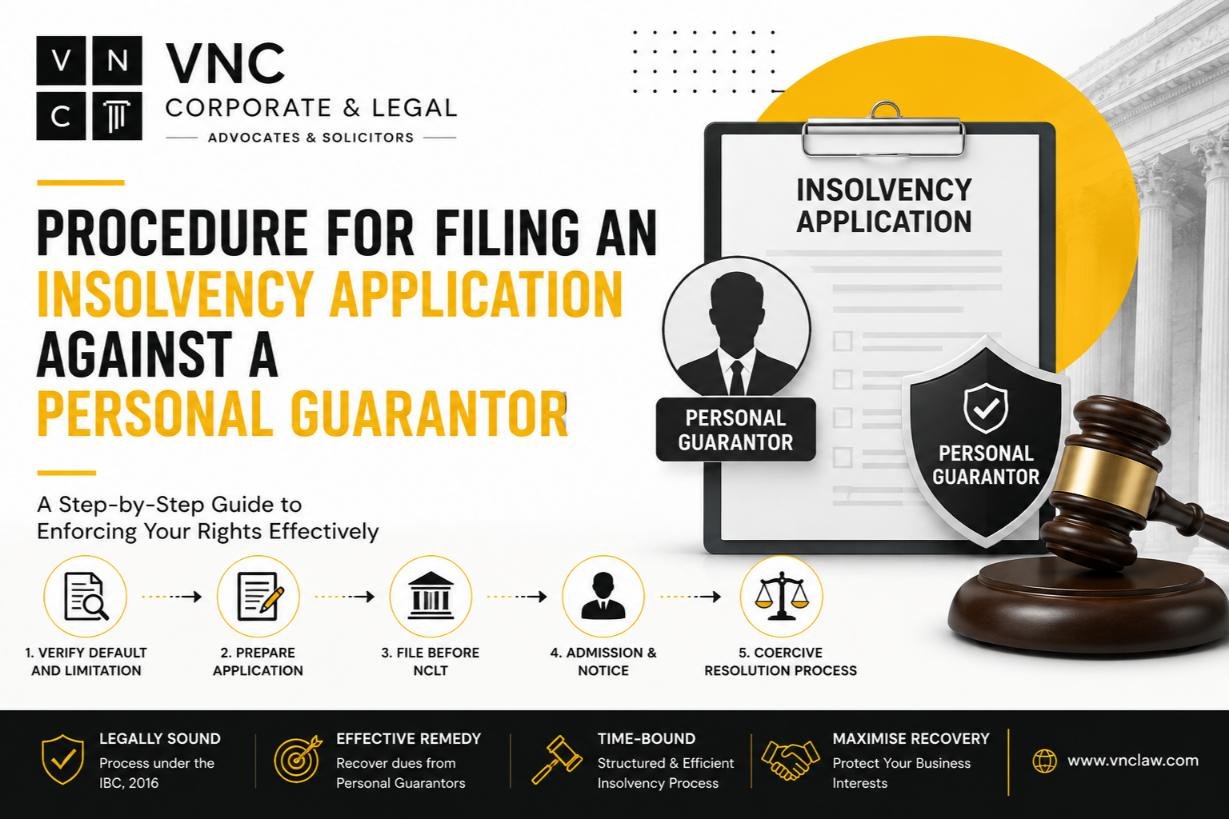
1. Introduction
Lenders — banks, NBFCs and financial institutions — routinely take personal guarantees from promoters, directors and key shareholders as additional comfort while extending credit to a corporate borrower. Where the corporate borrower defaults and the guarantee is invoked without payment, the Insolvency and Bankruptcy Code, 2016 gives the creditor an independent, time-bound forum to proceed against the guarantor personally — separate from, and not contingent upon, any insolvency proceeding against the corporate debtor.
This route was activated by the Central Government notification dated 15 November 2019, which brought into force Sections 78, 79, and 94 to 187 of the Code (Part III, Chapter III) specifically for personal guarantors to corporate debtors, along with the Insolvency and Bankruptcy (Application to Adjudicating Authority for Insolvency Resolution Process for Personal Guarantors to Corporate Debtors) Rules, 2019 (“the 2019 Rules”) and Regulations issued by the IBBI for the conduct of the process.
The constitutional validity of this selective notification — bringing personal guarantor provisions into force ahead of general individual insolvency — was upheld by the Supreme Court in Lalit Kumar Jain v. Union of India, (2021) 9 SCC 321, which is the anchor judgment for this entire procedure and is discussed in Part 9 below.
2. Key Statutory Concepts
2.1 Who is a “Personal Guarantor”
Section 5(22), IBC defines a personal guarantor as an individual who is the surety in a contract of guarantee to a corporate debtor. Only guarantees given in favour of a corporate debtor (not an individual or partnership borrower) fall within this Part III mechanism.
2.2 Adjudicating Authority and Jurisdiction
Under Section 60(1) and 60(2), IBC, the National Company Law Tribunal (NCLT) having territorial jurisdiction over the place where the registered office of the corporate debtor is located is the Adjudicating Authority — not the Debt Recovery Tribunal (DRT), even though the guarantor is an individual. This was expressly settled in Lalit Kumar Jain and again in State Bank of India v. Mahendra Kumar Jajodia and subsequent NCLAT rulings. Where insolvency proceedings against multiple guarantors of the same corporate debtor are pending, Section 60(3) permits consolidation before the same NCLT bench for judicial efficiency (see also Bank of Baroda v. Farooq Ali Khan, NCLAT).
2.3 Independence from Corporate Insolvency
Proceedings against a personal guarantor do not require a pending or concluded CIRP against the corporate debtor. Approval of a resolution plan for the corporate debtor, or its liquidation, does not automatically discharge the guarantor’s liability — the guarantee is an independent, co-extensive contract under Section 128, Indian Contract Act, 1872, a principle affirmed in Lalit Kumar Jain and Committee of Creditors of Essar Steel India Ltd. v. Satish Kumar Gupta, (2020) 8 SCC 531.
3. The Two Routes into the Process
Part III contemplates the IRP being triggered either by the guarantor himself or by a creditor:
| Section 94 — Guarantor’s own application | Section 95 — Creditor’s application |
| Filed by the personal guarantor, voluntarily, on his own default. | Filed by a creditor (financial or operational) of the guarantor, on the guarantor’s default. |
| Same Form and broadly the same downstream process. | This is the route a lender uses — the primary subject of this article. |
| Guarantor cannot file if a S.95 application by a creditor is already pending against him. | Creditor may proceed even where no action has been taken against the principal borrower or the corporate debtor. |
The remainder of this article focuses on the Section 95 creditor-initiated route, since that is the mechanism a lender invokes to pursue a defaulting guarantor.
4. Pre-Filing Conditions and Documentation
Before drafting the application, the following must be in place and evidenced:
- Existence of a valid guarantee — a duly executed and (where applicable) stamped and registered deed of guarantee, board resolution/consent (if the guarantor executed it in a representative capacity is irrelevant, since liability here is personal), and the underlying facility/loan documents to which the guarantee relates.
- Default by the principal borrower — classification of the underlying facility as a Non-Performing Asset (NPA) as per RBI IRAC norms, or in any case a clear, evidenced default under the facility agreement.
- Invocation of the guarantee — a written notice invoking the guarantee and calling upon the guarantor to pay the guaranteed amount within the period stipulated in the guarantee deed. While NCLT benches have taken a liberal view where invocation was informal or omitted, best practice and prudence require a clean, unambiguous invocation notice issued before the S.95 application, since some benches (e.g., certain NCLAT decisions) have treated invocation as a precondition to the debt becoming due and payable by the guarantor.
- Determination and quantification of default — a clear, computable amount in default as on the date of application, supported by statement of account, loan recall notice, and (if applicable) a certificate under the Bankers’ Books Evidence Act, 1891.
- Record of default with an Information Utility (if available) — under Section 99(4) read with Regulation 7 of the applicable IBBI Regulations, though absence of an IU record is not fatal; other evidence of default suffices.
- Proposal of a Resolution Professional (RP) — the applicant creditor must propose the name of an Insolvency Professional to act as Resolution Professional, along with his/her written consent in Form B of the 2019 Rules, and confirmation that no disciplinary proceedings are pending against the IP.
5. Limitation
The Limitation Act, 1963 applies to applications under Part III by virtue of Section 238A, IBC. The limitation period is three years and generally runs from:
- the date of default by the guarantor (i.e., failure to pay upon invocation), or
- in continuing default situations, from the date of NPA classification of the underlying account, subject to fresh causes of action arising from written acknowledgments under Section 18 of the Limitation Act (e.g., balance confirmation letters, OTS proposals, part-payments).
Where the corporate debtor’s CIRP was itself initiated within limitation, or where a recovery suit/SARFAESI action is pending against the guarantor, these can furnish continuing causes of action or acknowledgments extending limitation — this needs to be checked on the specific facts and correspondence trail.
6. Step-by-Step Procedure under Section 95
Step 1 — Draft and serve invocation and demand notice
Issue a notice invoking the guarantee and demanding payment of the outstanding amount within the period specified in the guarantee deed (or a reasonable period if none is specified). Preserve proof of delivery (courier POD, email, registered post acknowledgment).
Step 2 — Obtain consent of proposed Resolution Professional
Approach an Insolvency Professional registered with the IBBI, share the case summary, and obtain written consent in Form B (Annexure to the 2019 Rules) confirming willingness to act and disclosing no conflict of interest.
Step 3 — Prepare the application in Form C
The creditor’s application under Section 95(1) is filed in Form C prescribed under the 2019 Rules, and must annex:
- Details of the debt and the guarantee (guarantee deed, facility documents).
- Record/evidence of default (statement of account, NPA letter, recall notice).
- Copy of the invocation notice and proof of service.
- Consent of the proposed RP (Form B) and his/her registration details.
- A list of security interests, if any, held by the applicant over the guarantor’s assets.
- An affidavit in support, verified in the manner prescribed.
- Proof of payment of the requisite filing fee before the NCLT Registry.
Step 4 — File before the jurisdictional NCLT
File Form C, along with the vakalatnama, index and annexures, before the NCLT bench having jurisdiction over the registered office of the corporate debtor (per Section 60(1)), not the guarantor’s place of residence.
Step 5 — Appointment of Resolution Professional by the Adjudicating Authority
Under Section 97, within seven days of filing, the NCLT directs the Insolvency and Bankruptcy Board of India (IBBI) to confirm that no disciplinary proceeding is pending against the proposed RP; the IBBI must communicate this within ten days, following which the NCLT appoints the RP (Section 97(3)-(5)).
Step 6 — Interim-moratorium takes effect automatically
Under Section 96, the moment the application is filed, an interim-moratorium commences automatically (no separate order is needed) and continues until the application is admitted or rejected under Section 100. During this period:
- all pending legal actions/proceedings for any debt of the guarantor are deemed stayed;
- the guarantor is restrained from transferring, alienating or disposing of any assets or legal right/beneficial interest therein;
- this interim-moratorium does not extend to the corporate debtor’s own assets and does not affect the guarantor’s employment, business, or right to continue transactions specified by the Adjudicating Authority.
Step 7 — RP examines the application and submits a report
Under Section 99, the RP examines the application within ten days of appointment to determine whether the application is complete and whether the alleged default has actually occurred, and submits a report to the Adjudicating Authority recommending admission or rejection, along with reasons. The guarantor is required to be given an opportunity to submit his stand/objections during this examination, per settled NCLAT practice reading Section 99 with principles of natural justice (see Sanjay Kumar Ruia v. Catholic Syrian Bank Ltd., NCLAT).
Step 8 — Admission or rejection by the Adjudicating Authority
Under Section 100, within fourteen days of receipt of the RP’s report, the NCLT must either admit or reject the application, recording reasons. If admitted, the interim-moratorium under Section 96 gives way to a moratorium under Section 101, which continues until the repayment plan is approved or the guarantor is discharged/adjudicated bankrupt, as the case may be.
7. Post-Admission: Repayment Plan and Beyond
7.1 Public notice and submission of claims
On admission, a public notice is issued inviting claims from creditors of the guarantor, and the RP prepares a
7.2 Preparation and submission of the repayment plan
The guarantor, in consultation with the RP, prepares a repayment plan under Section 105, which must provide for the manner of restructuring the guarantor’s affairs, or realisation of assets, for repayment of debts. The RP submits the plan with his report to the Adjudicating Authority under Section 106.
7.3 Meeting of creditors and approval
Under Sections 107–111, a meeting of creditors is convened; the repayment plan requires approval by a majority of more than three-fourths in value of creditors present and voting. The approved plan (or the Authority’s decision on a rejected plan) is then confirmed/implemented under Sections 112–115.
7.4 Discharge or move to bankruptcy
On full implementation of the repayment plan, the Adjudicating Authority passes a discharge order under Section 116. If the repayment plan is rejected or fails, or if no plan is approved, any creditor (including the applicant) may apply for a bankruptcy order against the guarantor under Sections 121–126 (Chapter IV, Part III), leading to appointment of a Bankruptcy Trustee, vesting of the estate, and eventual distribution and discharge of the guarantor from remaining debts under Section 138.
8. Indicative Timeline
| Stage | Statutory Timeline |
| Filing of Form C application (S.95) | Within limitation (3 years from default/acknowledgment) |
| IBBI confirmation on proposed RP | Within 10 days of NCLT’s reference |
| Appointment of RP by NCLT | Within 7 days of application (subject to IBBI confirmation) |
| Interim-moratorium (S.96) | Automatic from date of filing till admission/rejection |
| RP’s examination and report (S.99) | Within 10 days of appointment |
| Admission/rejection by NCLT (S.100) | Within 14 days of receipt of RP report |
| Repayment plan meeting and voting | As directed by RP/Adjudicating Authority |
These timelines, though directory in practice given NCLT case-loads, form the statutory scaffolding and should be tracked and referenced in follow-up applications for expeditious disposal.
9. Key Judicial Precedents
- State Bank of India v. V. Ramakrishnan, (2018) 17 SCC 394 — held that Section 14 moratorium in a corporate debtor’s CIRP does not extend to protect personal guarantors; their independent liability survives.
- Lalit Kumar Jain v. Union of India, (2021) 9 SCC 321 — upheld the validity of the 15 November 2019 notification bringing Part III into force for personal guarantors; confirmed NCLT jurisdiction over such applications; and held that approval of a resolution plan for the corporate debtor does not, by itself, discharge the personal guarantor.
- Committee of Creditors of Essar Steel India Ltd. v. Satish Kumar Gupta, (2020) 8 SCC 531 — clarified that approval of a resolution plan does not extinguish claims against guarantors, reinforcing the co-extensive nature of guarantor liability.
- Sanjay Kumar Ruia v. Catholic Syrian Bank Ltd. — NCLAT clarified the guarantor’s right to be heard and the scope of the RP’s examination under Section 99.
- Bank of Baroda v. Farooq Ali Khan and connected NCLAT/High Court decisions — addressed consolidation of multiple personal guarantor applications and procedural aspects of Section 95 filings.
Citations above are for orientation; always verify current standing and cross-check neutral citations before relying on them in pleadings.
10. Practical Filing Checklist
- Guarantee deed — original/certified copy, stamping and execution verified
- Underlying facility agreement(s) and sanction letters
- Statement of account / loan ledger showing default
- NPA classification letter, if applicable
- Loan recall notice issued to the principal borrower
- Guarantee invocation notice and proof of service on the guarantor
- Computation of amount in default, with interest basis clearly stated
- Information Utility record of default, if available
- Form B — written consent of the proposed Resolution Professional
- Form C application, verifying affidavit, vakalatnama, index
- NCLT filing fee — payment proof
- Corporate debtor’s CIN/registered office details (for jurisdiction)
11. Conclusion
The personal guarantor mechanism under Part III of the IBC gives lenders a focused, time-bound recovery route that runs independently of — and often faster than — proceedings against the corporate debtor. Its success in practice turns on disciplined pre-filing groundwork: a clean invocation of the guarantee, a well-quantified default, a cooperative and properly consented Resolution Professional, and a Form C application that anticipates the RP’s Section 99 scrutiny. Handled this way, the process gives creditors real leverage against promoter and director guarantees that might otherwise sit unenforced for years.
— VNC Corporate & Legal, Advocates & Solicitors