
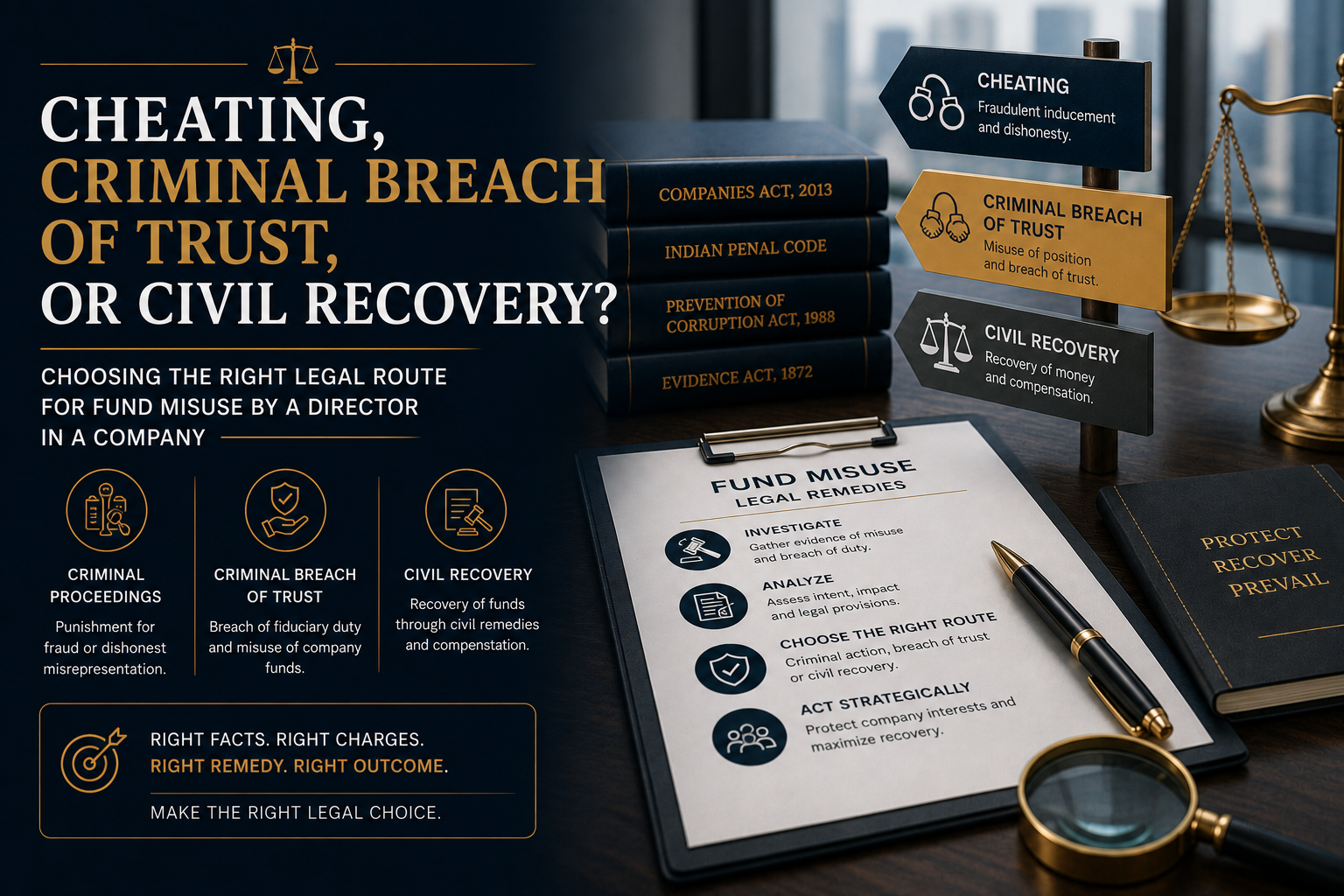
A practical and doctrinal guide to the three legal pathways available when a director diverts company or investor funds — and why picking the wrong one can sink the whole case
Introduction
When a director diverts company funds for personal use, the instinctive reaction of most boards, co-founders, or investors is to reach for the most serious-sounding label available — “cheating,” “fraud,” “criminal breach of trust” — and file a police complaint invoking all of them at once. This instinct is understandable, but it is also one of the most common and most damaging mistakes made in fund-misuse disputes in India today. Indian courts have, with increasing consistency over the last three years, thrown out precisely this kind of over-charged complaint — not because the underlying misconduct wasn’t real, but because the legal characterisation was wrong, and getting it wrong can result in the entire criminal proceeding being quashed, leaving the aggrieved party having burned time, money, and credibility on a case that never had a proper legal foundation.
This article sets out, in detail, the three distinct legal routes available when a director misuses company or investor funds — cheating, criminal breach of trust, and civil recovery — how Indian law draws the line between the first two (a line the Supreme Court has now described as making them “antithetical” to one another), and a practical framework for deciding which route, or combination of routes, actually fits a given fact pattern.
The Three Routes, at a Glance
- Cheating (Section 318, Bharatiya Nyaya Sanhita, 2023 — formerly Section 420, IPC): applies where the director never had lawful entitlement to the funds in the first place — they obtained investment, disbursement, or access to funds through deception, with dishonest intent present from the very outset of the transaction.
- Criminal Breach of Trust (Section 316, BNS — formerly Sections 405–409, IPC): applies where the director was lawfully entrusted with the funds — as part of their legitimate role and authority — and only later, after receiving lawful control, dishonestly misappropriated or converted them.
- Civil Recovery (breach of fiduciary duty under Section 166 of the Companies Act, 2013, oppression and mismanagement proceedings under Sections 241–242, or a civil suit for accounts and damages): does not require proving criminal intent at all — only that the director breached the standard of conduct owed to the company, and seeks to recover the money or the undue gain, rather than to punish.
The critical, and frequently misunderstood, point is this: the first two routes are not simply “different levels of the same offence.” They rest on fundamentally different — and mutually exclusive — factual narratives. Choosing between them is not a matter of severity; it is a matter of which story the facts actually tell.
Cheating vs. Criminal Breach of Trust: The Legal Line, and Why It’s Absolute
The Doctrinal Foundation
The Supreme Court’s 1956 ruling in Jaswantrai Manilal Akhaney v. State of Bombay remains the foundational authority establishing that cheating and criminal breach of trust are mutually exclusive offences, because the mental state required for each is fundamentally incompatible. This principle has been consistently applied ever since, and — crucially — was carried forward without alteration into the Bharatiya Nyaya Sanhita, 2023.
The dividing line is often called the “timing test”:
- In cheating, the dishonest or fraudulent intention exists from the very inception of the transaction. The director makes a false or misleading representation that induces the company, an investor, or a co-shareholder to part with money or property. The deception is baked into the transaction from the start.
- In criminal breach of trust, the director receives the funds lawfully — as part of their legitimate authority, role, or a fiduciary relationship — and it is only afterward that they dishonestly misappropriate, convert, or misuse what was properly entrusted to them.
The Supreme Court’s decision in Hridaya Ranjan Prasad Verma v. State of Bihar (2000) 4 SCC 168 remains the leading case for identifying when a broken promise crosses over into criminal cheating, holding that the culpable intention must be shown to have existed at the time the inducement was made — a subsequent failure to perform, without more, does not retroactively convert a civil breach into a criminal one.
The 2024–2025 Line of Supreme Court Rulings
A consistent and increasingly firm judicial trend has crystallised over the last two years, specifically addressing the practice of charging both offences together on the same set of facts:
- In A.M. Mohan v. State (2024) INSC 233, the Supreme Court quashed an FIR arising out of a transaction worth over ₹16 crore, holding that on the complainant’s own version of events, there was no dishonest inducement at the outset — the dispute was, in substance, a civil one.
- In a landmark ruling delivered on 23 August 2024, a Supreme Court bench comprising Justices J.B. Pardiwala and Manoj Misra held explicitly that offences of cheating and criminal breach of trust are “antithetical” to one another and cannot be simultaneously charged on the same factual matrix — because one offence begins with deception at inception, and the other begins with lawful trust that is later betrayed. The Court noted that this principle carries forward unchanged into Sections 318 and 316 of the BNS.
- Arshad Neyaz Khan v. State of Jharkhand (2025) INSC 1151 reaffirmed this position in a property-related dispute, quashing simultaneous proceedings under both provisions and observing that criminal law must not be weaponised to pursue what is, in substance, a debt-recovery exercise or a personal score-settling mechanism dressed up as a criminal complaint. The Court specifically noted that an eight-year delay in filing the underlying complaint raised doubts about the complainant’s bona fides.
- Jupally Lakshmikantha Reddy v. State of Andhra Pradesh (2025) INSC 1096 reiterated that cheating requires a false representation of a material fact that actually induced the complainant to act — a general sense of having been let down commercially is not enough.
- At the High Court level, the Orissa High Court in Priyam Pratham Sabat v. State of Odisha (2025) set aside a magistrate’s order that had taken cognizance of both Section 316 and Section 318 BNS simultaneously on the same facts, directing the trial court to reconsider and pass a reasoned order that actually engages with which of the two — not both — the facts support.
What This Means for a Director Fund-Misuse Case, Concretely
Applying the timing test to typical director fund-misuse fact patterns:
- A director who raised investment by misrepresenting the company’s financials, use of funds, or their own intentions, and diverted the money almost immediately — this points toward cheating (Section 318), because the dishonest intent existed before the money ever changed hands.
- A director who was properly authorised to operate company bank accounts as part of their role, and later used company funds to pay personal expenses, service personal loans, or make undisclosed transfers to related entities — this points toward criminal breach of trust (Section 316), because the initial receipt and control of the funds was entirely lawful; the wrongdoing occurred only in how the funds were subsequently used.
- A director who, over time, both (a) induced a specific fresh investment through false representations and (b) separately misapplied funds they were legitimately administering — this may genuinely involve both offences, but they must be charged in relation to distinct transactions, each mapped to its own timeline of intent — not bundled together as though they describe the same wrongdoing.
Getting this characterisation right at the drafting stage — in the complaint itself — is not a technicality. Mis-framing both offences together on the same facts is now a well-recognised, judicially endorsed ground for quashing under Section 482 of the CrPC (now the equivalent provision under the BNSS), and a quashed complaint often forecloses re-filing on the same facts, making this an unforgiving error to make.
Section 447 of the Companies Act: The Company-Specific Fraud Route
Where the fund misuse occurred within a company (as opposed to a purely personal transaction between individuals), a further, company-specific criminal route exists under Section 447 of the Companies Act, 2013, which defines and punishes “fraud” in relation to a company’s affairs, carrying a punishment of imprisonment and a fine that can extend up to three times the amount involved in the fraud.
There is an important procedural constraint here that is frequently misunderstood: under Section 212(6), cognizance of a Section 447 offence can be taken by the Special Court only on a complaint filed by the Director of the Serious Fraud Investigation Office (SFIO) or a specifically authorised Central Government officer — a private party cannot directly initiate a Section 447 prosecution, and the Supreme Court has recently confirmed that this bar extends to connected offences (such as Sections 448 or 451 of the Companies Act) where the substance of the allegation is genuinely one of fraud. Where the facts support Section 447 characterisation, the correct first step for an aggrieved shareholder or investor is typically an application to the NCLT under Section 213 seeking an investigation into the company’s affairs — not a private criminal complaint.
The Civil Recovery Route: Getting the Money Back, Not Just a Conviction
A criminal conviction — even where fully successful — does not, by itself, put money back in the company’s account. Recovery of the actual funds requires a separate, and often parallel, civil or company-law track.
Breach of Fiduciary Duty Under Section 166
Section 166 of the Companies Act, 2013 codifies a director’s fiduciary duties — to act in good faith, in the company’s best interests, and to avoid conflicts of interest. Section 166(5) specifically prohibits a director from making any “undue gain or advantage” by virtue of their position, and requires that any such gain be repaid to the company. This provision gives the company a direct, civil law basis to sue a director for the return of diverted funds, independent of any criminal proceeding.
The Delhi High Court’s ruling in Rajeev Saumitra v. Neetu Singh (2016) confirmed that a company (or, in an appropriate derivative action, its shareholders) has locus standi to bring civil proceedings against a director for undue advantages taken in breach of Section 166 duties. The Supreme Court’s earlier decision in Dale & Carrington Invt. (P) Ltd. v. P.K. Prathapan (2005) 1 SCC 212 — where directors issued shares to themselves to entrench control — remains a leading authority on directors being held to account for self-dealing in breach of fiduciary obligations, with the allotment set aside and the original position restored.
An Important Limitation: Personal Remedy, Not Automatically a Proprietary One
A genuinely important, and often overlooked, technical point: Section 166’s statutory remedy, on its own terms, is a personal remedy — an order that the director return the undue gain or compensate the company. It does not, by itself, expressly provide a proprietary remedy such as a constructive trust over specific assets the director purchased with the misappropriated funds. Legal commentary has noted this as a genuine gap in the 2013 Act’s codification of directors’ duties, in contrast to jurisdictions like the UK, where the statute more clearly preserves common law and equitable remedies alongside the codified duties.
In practice, this means that where a director has used diverted funds to acquire a specific traceable asset — a property, a vehicle, shares in another entity — a company seeking to recover that specific asset (rather than simply a money judgment against a director who may have few realisable assets left) may need to plead common law and equitable doctrines such as account of profits and constructive trusteeship alongside the statutory Section 166 claim, rather than relying on Section 166 alone. This is a live, unsettled area of Indian company law, and strategic pleading matters considerably here.
The NCLT Route: Oppression and Mismanagement
Where fund misuse forms part of a broader pattern of director misconduct affecting minority shareholders — not just an isolated financial diversion — Sections 241–242 of the Companies Act give the NCLT wide powers, including ordering the erring director’s removal, regulating the company’s affairs, and ordering restitution. This route does not require proving criminal intent to the standard a criminal court demands, and can run in parallel with a criminal complaint, since the two proceedings serve different purposes and operate before different forums.
The Winding-Up Backstop: Section 340
Where a company is undergoing winding up and it emerges that a director has misapplied or retained company funds, or is guilty of misfeasance in relation to the company, Section 340 of the Companies Act, 2013 allows the Tribunal, on the application of the liquidator or a creditor/contributory, to examine the director’s conduct and order repayment or compensation as it considers just — a mechanism specifically designed for exactly the fund-misuse scenario this article addresses, where it surfaces during insolvency or winding-up proceedings.
Choosing the Right Route: A Practical Framework
Rather than defaulting to “file everything and see what sticks” — a strategy Indian courts have now repeatedly punished — the choice of route should be driven by a structured assessment:
- What does the timeline of intent actually show? Was the director dishonest from the moment they obtained access to or control of the funds (cheating), or did they receive the funds lawfully and misuse them later (criminal breach of trust)? This is the threshold question, and it should be answered before any complaint is drafted, not worked out after the fact under judicial scrutiny.
- Is speed of asset freezing the priority, or is proof beyond reasonable doubt realistically achievable? A criminal complaint can trigger police investigation, potential arrest, and — where the funds have moved through a bank account — the possibility of freezing action, often faster than a civil suit can secure interim relief. But criminal proceedings require proof beyond reasonable doubt, a materially higher bar than the civil standard of preponderance of probability.
- Is the actual objective recovery of money, or accountability and deterrence? If the primary goal is getting the company’s money back, a civil suit for breach of fiduciary duty (Section 166), potentially combined with a Section 241–242 oppression petition, is usually the more direct route to a monetary or restitutionary order — a criminal conviction alone does not return the funds.
- Has the fund misuse been formally investigated at the company level, or does it justify SFIO/NCLT involvement? For genuinely large-scale or systemic fraud (as opposed to a single director’s personal misappropriation), Section 213 NCLT investigation and, where appropriate, SFIO referral under Section 212 may be the more powerful — and procedurally correct — route, particularly where Section 447 characterisation is in play.
- Can a dual-track strategy be run without one undermining the other? In practice, a well-advised complainant often pursues civil recovery and a properly characterised criminal complaint in parallel — but this requires care to ensure the criminal complaint is built on a coherent, singular theory of the offence (cheating or breach of trust, correctly matched to the facts) rather than an alternative or cumulative charge that invites exactly the kind of quashing the Supreme Court’s recent rulings have made increasingly likely.
- Is there a genuine risk this looks, on its face, like a civil dispute repackaged as a criminal complaint? Courts are now acutely alert to this pattern — a business relationship gone wrong, a delayed repayment, or a disputed accounting treated as fraud. If the underlying facts are genuinely more consistent with a commercial disagreement than dishonest intent from the outset or a clear breach of lawful entrustment, a criminal complaint is likely to be quashed, and the better strategic choice is to lead with the civil and company-law remedies instead.
The Broader Trend: Courts Pushing Back on Criminalised Civil Disputes
The consistent thread running through the 2022–2025 Supreme Court rulings discussed above — Vijay Kumar Ghai v. State of West Bengal (2022) 7 SCC 124, Deepak Gaba v. State of Uttar Pradesh (2023) 3 SCC 423, A.M. Mohan (2024), and Arshad Neyaz Khan (2025) — is a sustained judicial effort to draw a firmer line between genuine criminal wrongdoing and business disputes that complainants attempt to escalate into criminal matters for leverage, urgency, or simply because a criminal complaint feels more forceful than a civil suit. This is directly relevant strategy for anyone considering a complaint against a director for fund misuse: a criminal complaint that cannot survive this level of judicial scrutiny is not just unsuccessful — it can actively weaken the complainant’s position in any parallel civil recovery effort, by creating a public record of a court finding the underlying narrative legally deficient.
Conclusion
Fund misuse by a director is rarely a single, cleanly labelled wrong — it sits at the intersection of criminal law’s two historically distinct offences and an entirely separate civil and company-law framework aimed at restitution rather than punishment. The temptation to invoke every available label at once is understandable, but Indian courts have made unmistakably clear, across a dense run of rulings between 2022 and 2025, that this approach now carries real risk: a wrongly characterised or over-charged complaint is increasingly likely to be quashed outright, rather than simply narrowed.
The more effective approach — and the one increasingly rewarded by courts — is to work backward from the facts: identify precisely when dishonest intent actually entered the picture, match that timeline to the correct offence (or correctly conclude that no criminal offence is made out at all), and build the recovery strategy around the combination of civil, company-law, and — where genuinely warranted — criminal remedies that the facts actually support.
This article is intended for general informational purposes and does not constitute legal advice. Companies, shareholders, and investors facing suspected fund misuse by a director should have the specific facts and evidentiary record assessed before deciding which legal route, or combination of routes, to pursue.
If your company or board is dealing with suspected fund misuse by a director and needs help deciding between criminal, civil, and company-law remedies, feel free to reach out to VNC Corporate & Legal, Advocates & Solicitors.