
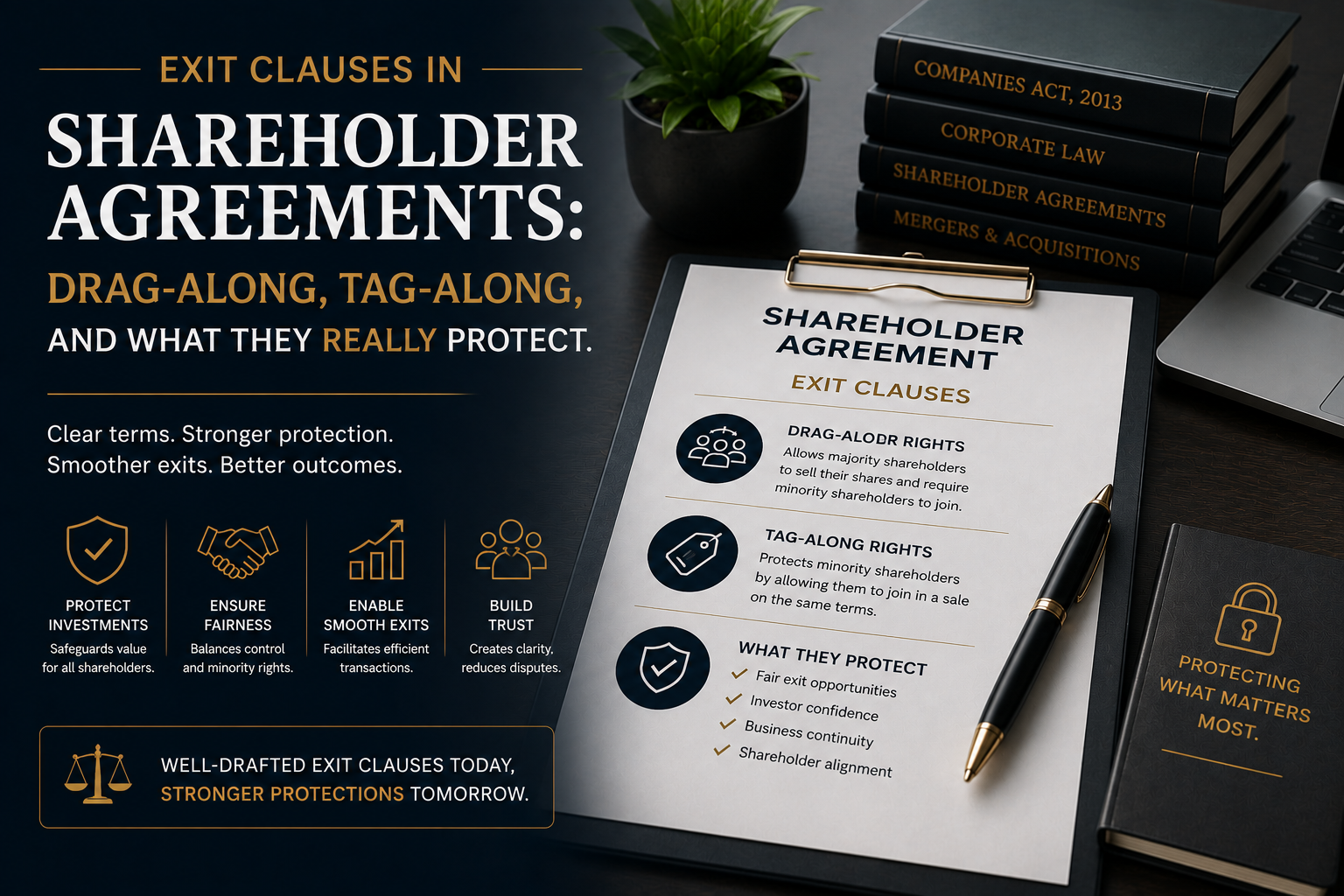
Exit Clauses in Shareholder Agreements: Drag-Along, Tag-Along, and What They Really Protect
A founder’s guide to the two clauses that decide who controls your company’s exit — with worked examples
Why This Should Matter to You, the Founder
Here’s a scenario that plays out more often than most founders expect: your startup gets a real acquisition offer. Not a term sheet from an investor — an actual buyer, wanting to purchase the entire company. The price is good. Your lead investor is thrilled. And then you discover that one early angel investor, who wrote a small cheque three years ago and hasn’t been involved since, doesn’t want to sell. Legally, unless your shareholders’ agreement anticipated this exact moment, that one holdout can block — or at minimum, seriously complicate — a deal that everyone else wants.
This is precisely the problem drag-along and tag-along clauses exist to solve. They sit in the “exit mechanics” section of nearly every shareholders’ agreement (SHA), usually skimmed past during term sheet negotiations because an actual exit feels distant and hypothetical. It isn’t hypothetical. It is, for a successful company, the single most financially consequential event in its life — and these two clauses largely decide who gets a say in how it happens.
This article walks through both clauses in detail, with worked numerical examples, the Indian legal framework that governs whether they actually hold up in court, and what founders specifically should watch for when negotiating them.
The Two Clauses, in Plain English
Drag-along rights let a majority shareholder (or a defined threshold, such as shareholders holding 75% of equity) who has agreed to sell their shares to a third party force the remaining minority shareholders to sell their shares too, on the same price and terms. It exists to protect the majority — and, just as importantly, to protect any buyer, who almost never wants to acquire 85% of a company and be stuck with unpredictable minority shareholders forever.
Tag-along rights (also called co-sale rights) work in the opposite direction: they let a minority shareholder insist on joining a sale that a majority shareholder has negotiated, selling their own shares on the same price and terms. It exists to protect the minority from being left behind — holding shares in a company that has just been bought by an entirely new controlling shareholder they never agreed to be in business with, while the founders or lead investors cash out and walk away.
Founders should note something important upfront: depending on where you sit in your own cap table, you will be on different sides of these two clauses at different points in your company’s life. As a founder in the early years, you’re usually the majority shareholder benefiting from drag-along rights. By the time your Series B or C investors come in, you may hold a minority stake yourself and be relying on tag-along protection to make sure you’re not left holding shares in a company now controlled by someone else’s decisions.
Drag-Along Rights: A Worked Example
The setup: Ananya and Rohan co-founded Kestrel Analytics five years ago. After a seed round and a Series A, the cap table looks like this:
| Shareholder | Stake |
|---|---|
| Ananya & Rohan (founders) | 55% |
| Sundara Capital (Series A investor) | 30% |
| Early angel — Mr. Verma | 8% |
| ESOP pool | 7% |
A larger competitor offers to acquire 100% of Kestrel Analytics for ₹120 crore — a genuinely good outcome for everyone. Ananya, Rohan, and Sundara Capital (collectively holding 85%) want to proceed. Mr. Verma, however, is unhappy with the valuation — he thinks the company is worth more and doesn’t want to sell.
Without a drag-along clause: the acquirer either has to buy the company subject to Mr. Verma remaining a shareholder (which most acquirers refuse — nobody wants an unpredictable minority holder in a company they just bought), or the deal collapses entirely, or the majority ends up privately negotiating a side payment just to convince Mr. Verma to go along — effectively letting an 8% shareholder hold the other 92% to ransom.
With a properly drafted drag-along clause (typically triggered once shareholders holding a specified threshold — commonly 50-75% — agree to a sale): Ananya, Rohan, and Sundara Capital can issue a drag-along notice to Mr. Verma. He is contractually required to sell his 8% stake to the acquirer, at the same ₹120 crore valuation, on the same terms as everyone else. He receives his full, fair share of the proceeds — he simply doesn’t get a veto over a deal the overwhelming majority has approved.
The founder’s takeaway: a drag-along clause is what makes your company genuinely “exit-ready.” Sophisticated acquirers and their lawyers will specifically check for one during diligence — its absence is a real red flag that can depress your valuation or kill a deal outright, because it signals that a clean 100% acquisition might not actually be achievable.
Tag-Along Rights: A Worked Example
The setup: Now imagine the reverse situation at a different company, Bluepeak Robotics. The founder, Kabir, holds 40% after several funding rounds. Meridian Growth Partners, the lead Series B investor, holds 45%, and a group of smaller investors and ESOP holders hold the remaining 15%.
Meridian decides to sell its entire 45% stake to a strategic buyer — a large industrial conglomerate — at a price that values Meridian’s stake highly, but the conglomerate only wants to buy Meridian’s shares, not acquire the whole company. If this sale proceeds without any protection for the others, Kabir and the smaller shareholders wake up the next day as minority shareholders in a company now effectively controlled by a large conglomerate they’ve never negotiated with, had no say in choosing, and whose future plans for the business (integration, cost-cutting, a completely different strategic direction) they have no way of predicting or influencing.
With a tag-along clause: Kabir and the other shareholders have the right to say, in effect, “if you’re selling, we’re selling too — on the same terms.” They can require the conglomerate to also purchase their shares, at the same per-share price Meridian negotiated, proportionate to their holding. This doesn’t force them to sell — tag-along is typically an option, not an obligation — but it guarantees they aren’t trapped as minority shareholders in a business whose new controlling party they never chose, without at least having the choice to exit on the same commercial terms as the party that triggered the change.
The founder’s takeaway: as a founder, once you’ve raised enough rounds that you’re no longer the majority shareholder, a strong tag-along right is one of your most important protections. It ensures that a large investor’s decision to exit doesn’t leave you locked into a company under new, unpredictable control — without at least the option to exit alongside them on equally good terms.
Why Indian Law Treats These Clauses Differently From What Founders Expect
This is the part most founders — and even many first-time investors — get wrong: drag-along and tag-along rights do not appear anywhere in the Companies Act, 2013. They are entirely contractual creatures, and their enforceability in India has a genuinely important, founder-relevant legal history.
The Foundational Problem: SHA vs. Articles of Association
The Supreme Court’s decision in V.B. Rangaraj v. V.B. Gopalakrishnan (1992) remains the starting point for this entire area of law. The Court held that a restriction on the transfer of shares is binding on the company only if it is incorporated into the company’s Articles of Association (AoA) — a private shareholders’ agreement, however carefully negotiated and signed, does not by itself bind the company if the same right isn’t mirrored in the AoA.
This matters enormously in practice. Many founders sign a detailed SHA with their investors — containing exactly the kind of drag-along and tag-along clauses discussed above — and assume the deal is done. If those provisions are never actually written into the AoA, the company itself may not be bound to recognise or register a share transfer executed under the drag-along or tag-along mechanism, even though all the human parties clearly agreed to it on paper.
Where the Law Has Moved Since
- Section 58(2) of the Companies Act, 2013 provides that any contract or arrangement between two or more persons in respect of the transfer of securities is enforceable as a contract — giving statutory footing to the idea that these rights, at minimum, bind the shareholders who actually signed the SHA, even if the mechanism for registering the resulting transfer still runs through the company’s own constitutional documents.
- Vodafone International Holdings BV v. Union of India (2012) 6 SCC 613 — while primarily a tax case — is significant here because the Supreme Court affirmed the contractual validity of tag-along and drag-along rights, and suggested that the Rangaraj restriction (requiring incorporation into the AoA) applies with full force to private companies, while public companies may be treated somewhat differently, particularly where the rights are being enforced for the company’s own benefit.
- The Delhi High Court’s decision in World Phone India Pvt. Ltd. v. WPI Group Inc., USA is the case every founder should actually internalise: where the AoA is silent on a right that a shareholders’ agreement grants (in that case, an affirmative voting right, but the same logic applies squarely to drag-along and tag-along mechanics), the right cannot be enforced against the company purely on the strength of the SHA. The company’s board had approved a rights issue strictly following the AoA — even though doing so contradicted a specific shareholder’s contractual veto right under the SHA — and the court held that the SHA-based right, not being reflected in the AoA, simply couldn’t override the board’s AoA-compliant action.
- The Bombay High Court’s approach in Western Maharashtra Development Corporation v. Bajaj Auto Ltd. took a somewhat more accommodating view, enforcing a shareholders’ agreement provision even though it wasn’t reflected in the Articles, on the basis that there was no direct conflict between the SHA provision and the AoA — illustrating that Indian courts have not applied Rangaraj with total rigidity, but the safer, more defensible position for any founder or investor remains to mirror the key rights in both documents rather than relying on judicial sympathy after the fact.
- A 2013 SEBI notification clarified that pre-emption rights, rights of first refusal, tag-along, and drag-along rights contained in shareholders’ agreements or Articles of Association do not require prior SEBI approval — removing one procedural hurdle, though this notification does not, by itself, resolve the underlying AoA-mirroring question above.
The Practical Rule for Founders
Every drag-along and tag-along right your company agrees to in an SHA should also be written into the Articles of Association, typically by way of a special resolution at the time the SHA is signed. This is not a formality your lawyer is padding the engagement with — it is the single most important step that determines whether these clauses actually work when you need them, rather than becoming the subject of a Section 241/242 oppression-and-mismanagement fight years later when a real exit is on the table and a dissenting shareholder discovers the SHA-only right may not bind the company.
Drafting Details That Actually Matter (and That Founders Often Miss)
Knowing that these clauses exist is the easy part. Getting the details right is where founders — particularly first-time founders negotiating their first serious term sheet — tend to give away more than they realise:
- The drag-along threshold. A clause triggered by a bare majority (50.1%) gives founders and lead investors enormous power to force a sale — including, in a worst-case scenario, a sale the founders themselves oppose if investors collectively cross the threshold. Many founder-favourable SHAs set this threshold higher (60-75%) and require the founders’ own consent as part of any qualifying majority, not just investor votes.
- Price and consideration parity. A well-drafted clause should require that dragged/tagging shareholders receive not just the “same price per share” in name, but genuinely the same form and timing of consideration — cash vs. escrow vs. earn-out structures can otherwise be manipulated to give the majority a materially better deal than the minority on paper “same terms.”
- Minimum valuation or price floor. Some founder-friendly SHAs include a floor — a drag-along right can only be exercised above a specified minimum valuation — to prevent a majority from forcing a distressed, undervalued sale purely to exit quickly.
- Carve-outs for the ESOP pool and key employees. A drag-along mechanism should clearly address what happens to unvested ESOP holders and any special retention arrangements for founders continuing to run the business post-acquisition — this is very often left ambiguous in template agreements and becomes a real point of friction during actual deal execution.
- Interplay with Right of First Refusal (ROFR). Tag-along and drag-along rights should be sequenced clearly against any existing ROFR — typically, ROFR is exercised first (giving existing shareholders the chance to buy out the selling shareholder themselves), and only if ROFR isn’t exercised does the drag-along/tag-along mechanism against a genuine third-party buyer come into play.
- Notice periods and mechanics. The clause should specify exactly how a drag-along notice is issued, how much time tagging shareholders have to elect to participate, and what happens if a tagging shareholder simply doesn’t respond within the window (typically deemed to have elected to participate, to avoid an inadvertent holdout).
Putting It Together: A Combined Exit Scenario
Returning to Kestrel Analytics from the earlier example — suppose the acquisition also triggers a tag-along right for the ESOP-holding employees who’ve vested their options. A properly drafted SHA and AoA would work like this in sequence:
- Ananya, Rohan, and Sundara Capital (85%) agree to sell to the acquirer at ₹120 crore.
- The drag-along clause is triggered (threshold met), and a drag-along notice is issued to Mr. Verma, compelling his 8% stake into the sale on identical terms.
- Simultaneously, vested ESOP holders are given the opportunity — via a tag-along right built specifically for the ESOP pool — to elect to sell their shares into the same transaction, at the same valuation, rather than being left holding shares in a company under new ownership.
- Because both the SHA and the AoA (amended by special resolution at the time of the Series A) contained matching drag-along and tag-along language, the company’s board is able to register the resulting share transfers without any shareholder having a credible legal basis to contest the process — precisely the clean, predictable outcome these clauses are designed to produce.
This is what “exit-ready” actually looks like in practice — not a company hoping everyone cooperates when the moment arrives, but a cap table where the mechanics of a clean exit were decided calmly, years in advance, before anyone knew exactly how much money or which shareholder would be affected.
Conclusion
Drag-along and tag-along clauses are frequently treated as boilerplate — the kind of term sheet language that gets nodded through because an actual acquisition or exit feels far away at the time of signing. In practice, they are among the most commercially significant clauses in any shareholders’ agreement, because they directly determine whether your company can execute a clean, complete exit when the moment finally comes — and whether you, personally, are protected or exposed depending on where you sit on the cap table at that time.
Get them right, and get them properly mirrored in your Articles of Association — not just your SHA — and an eventual exit becomes a straightforward commercial event. Get them wrong, or leave them as unenforceable good intentions sitting only in a private contract, and you risk discovering the gap at the worst possible moment: with a buyer at the table, a deal on the line, and one shareholder who never has to agree to anything at all.
This article is intended for general informational purposes and does not constitute legal advice. Founders and investors should have their specific shareholders’ agreement and Articles of Association reviewed together, as a single integrated document, before finalising any funding round or exit-related clause.
If you’re negotiating a term sheet, drafting your first shareholders’ agreement, or want your existing SHA and AoA checked for exactly this kind of gap, feel free to reach out to VNC Corporate & Legal, Advocates & Solicitors.